
Get Geared Up!

So you played a few times and you got the bug, time to gear up! The first thing most folks ask is "What's the best marker"? Depending on who you ask it will probably be the latest Dye, Lux or Planet Eclipse, you can pick one up new for $1200 to $1500. What's that? Don't have an "extra G" for a new marker? Neither do I! The good new is there are a lot of very good markers out there for around $300, new, and a lot of used equipment for a lot less! Like Mick said, "You can't always get what you want,..... but you can get what you need!
On the high end there are lots of great deals on used markers, and you can get last years models new for a couple of hundred less than they were before the latest model came out, and you can save a lot more on used markers. Start with your favorite field, most will let you fire the marker before you buy it so you know you are getting a working marker. Most fields will include a membership with a marker purchase, membership typically include free admission to the park for a year, leaving you more money to spend on paint! Talk to other players on the field, find out what they like and don't like about thier equipment, and if they have anything for sale. So what do you need?
Modern markers are so good that even a low priced marker can give outstanding performance. Lets look at what the most important factors are in choosing YOUR marker.

Fit
Notice I said YOUR marker, you need to make sure it fits you, like a glove! This is especially true for smaller players who have wrestle with large air tanks and often heavy rental markers. You want to be able to hold your marker up by your eye, elbows bent and tucked in, and you need to be able to do it for a long time, so you need to be comfortable. For this reason I see a real advantage to buying a "speed-ball" marker, They are smaller and lighter than thier "mil-sim" counterparts. Made of aluminum and durable plastics they are much easier for a smaller player to handle.
Rate of Fire
Rate of Fire is how fast a marker can shoot, 2 balls per second for example. Not long ago rate of fire was the big thing in paintball, not any more. Many markers don't even mention the rate of fire in their advertisements. Why not? Because just about any electronic marker will shoot faster than you are allowed to! Most fields and tournaments limit the ROF to around 12 BPS. So if your marker can shoot 30 BPS it doesn't really matter, you will never be allowed to shoot that fast, unless you play renegade.
Firing Modes
Like ROF this was once a big deal, but now most electros offer a variety of options from single shot to full auto. But most fields don't allow full auto, or ramping, so you won't use those modes much, until you play speed-ball.
Efficiency:
Efficiency refers to how well the marker uses air, how many shots you can get out of a tank. Even the most inefficient markers will get around 500 shots from a 68ci tank 4500psi tank. So unless you need to throw a lot of paint between fills don’t fret it too much!
Reliability:
Will it fire every time?
Sound, or lack thereof!:
Many of the new high end markers are very quiet, especially the spool valve markers.
Consistency:
One of the most important factors is consistency over the chronograph. A consistent marker shoots the balls out at the same velocity every time. Consistency is very important to accuracy, if you shot one shot at 250 fps and the next at 300 fps the 300 fps shot will hit higher than the 250 fps shot. High end markers today are all very consistent, many low end markers do a fine job as well, ask around, read reviews to find out which are the best.
Compressed Air vs. CO2
The two main compressed gasses used to power markers today are Carbon Dioxide or CO2 and Compressed Air, sometimes called "nitrogen". Compressed air is required for electronic markers and many mechanical markers. Make sure you buy the right tank for your marker! CO2 can damage many markers, all work with compressed air. (With the exception of the new Tippman C-3 which runs on propane!) CO2 tanks start at around $20, which makes them attractive compared to Compressed Air tanks that start around $100. So what's the problem with CO2? CO2 is a gas compressed into a liquid, which makes it cold, very cold! So cold that it can give you frostbite, or freeze your markers internals, burning up solenoids and freezing o-rings, which is why you can't use CO2 on electronic markers. CO2 can also cause serious problems with consistency. When a CO2 marker is pointed down liquid CO2 can run into the gun where it expands into a gas, which increase the internal pressure causing the marker to fire at a higher volocity, more feet per second. Every time I play I see players missing games because they could not get their marker back under 280 fps because it was full of CO2. Using an expansion chamber or a remote will help. You cannot fill a CO2 tank with compressed air.
Tanks
Once you decide which gas to use you still need to decide which tank to get, both CO2 and Compressed air tanks come in a wide variety of sizes.
Compressed Air Tanks
There are 3 specifications to consider in a compressed air tank.
Capacity: Measured in Cubic Inches gives you the capacity of the tank. The larger the size the more shots you get out of a fill. Capacity also dictates the tanks physical size. Make sure you buy a tank that is small enough so you can keep your gun in position for a long time, remember you want to be able to bend your elbows when you have your marker up! Smaller players need to use smaller tanks, or a drop-forward to bring the marker closer to their eye when they are aiming.
Tank Pressure: This is the maximum pressure you can fill the tank to, do not over-fill tanks, while tested well beyond their rated limits they can explode! Most tanks are either 3000 psi or 4500 psi, the higher the rating the more shots you can get out of a tank.
Regulator Pressure: Compressed air tanks are fitted with a regulator to control the air pressure feed to the marker. Tank pressures range from a couple hundred pounds to around one thousand, in this case more is not better! If you get a low pressure marker get a tank with a low pressure reg, a high pressure reg could, possibly damage the marker. High pressure markers need high pressure regulators to operate. Many tanks are adjustable, usually by changing a couple of spacers inside the regulator. NEVER WORK ON A FILLED TANK!
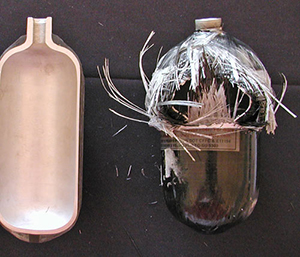
In addition to the specs you also have a choice of materials, steel tanks are heavier and more durable but cheaper than carbon wrapped tanks, you will pay more for a carbon wrapped tank, but they are lighter. You should get a tank cover for a carbon wrapped tank, they made from an aluminum tank wrapped in carbon thread then coated with a thick epoxy. If the epoxy gets chipped bad enough to damage the threads the tank must be discarded, repair is not possible. A tank cover is a good investment regardless, it helps keep the tank from slipping off you shoulder.
Compressed air tanks must be “Hydro-Tested” on a regular basis, every three or five years depending on the tanks construction. The tank’s born on date is printed on the side. All compressed air tanks must be destroyed after fifteen years.
CO2 Tanks:
About all you need to worry about with CO2 is the size, as long as you are comfortable with the tank it will work, as long as your gun can use CO2. You can expect to get 300 to 500 shots from a 9oz tank, around 1,000 from a 24 ounce tank.
Goggles
I didn't want to bore you with more safety stuff right off the bat, but you should buy yourself a good pair of gogs when you are getting geared up. If you have only used rental goggles up to now you know how beat up they can be, all scratched up with dirty lenses that are hard to see through. What you don't know is how good you can see through a nice clean pair of new goggles! Try on a few pair before you invest, make sure they cover your forehead and chin, or wear something to cover the exposed parts. The new trend in goggles is "low-profile". Paint almost always breaks when it hits goggles, so they are making the goggles smaller and the players are wearing soft hats and neck protectors so if they are hit the paintball might bounce off. Get goggles with anti-fog lenses; they will stay clear on the really humid days and the really cold ones as well. Anti-fog lenses generally have two thin lenses with a thin space between; this lets the outside lens get cold while the inside stays warm, or visa-versa, so no moisture condenses on the lens. Many new goggles come with a protective sheet on the inside of the lens, it is usually blue or yellow. Be sure to remove it. These sheets are so well applied that they are easy to miss, I have even seen experienced players use gogs for months not realizing there was sheet on the inside of their lens!